7 Signs Your Skin Barrier Is Damaged — and How to Fix It
Your skin barrier is the outermost layer of your skin — a thin but critical structure that keeps moisture in and irritants out. When it breaks down, you feel it. Tightness, stinging from products that never bothered you before, redness that won’t settle. Here are the seven clearest signs your barrier is compromised, and exactly what to do about each one.

In this guide
The 7 signs of a damaged skin barrier
Your skin feels tight after cleansing
A healthy barrier retains moisture even after washing. If your face feels tight, dry, or uncomfortable within minutes of cleansing — not just immediately after, but 10 to 20 minutes later — your barrier is struggling to hold onto water. This tightness is a sign that transepidermal water loss (TEWL) is elevated and the lipid layer is depleted.
Products that used to be fine now sting or burn
This is one of the most telling signs. Your serum, toner, or moisturiser hasn’t changed its formula — but your skin is reacting differently. A compromised barrier allows ingredients to penetrate too quickly and too deeply, triggering sensory nerve responses that a healthy barrier would block. If your skincare routine suddenly stings, it’s almost always a barrier issue, not a product issue.
Persistent redness without an obvious cause
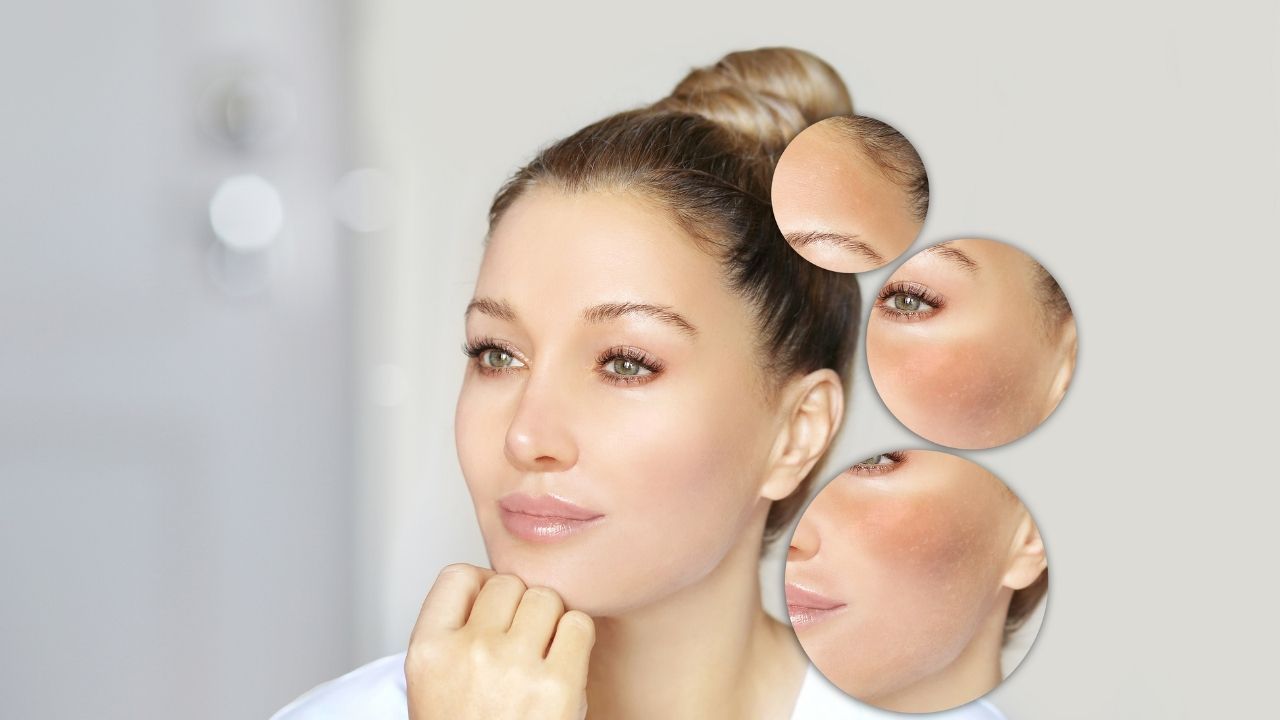
When the barrier breaks down, the skin is constantly exposed to low-level environmental irritants — air pollutants, hard water minerals, temperature changes — that a healthy barrier would filter out. This ongoing exposure triggers a low-grade inflammatory response that shows up as background redness, particularly across the cheeks, nose, and chin.
Skin that looks dull or feels rough despite moisturising
When ceramide levels fall and the barrier is disrupted, normal cell shedding (desquamation) becomes irregular. Dead cells accumulate unevenly on the surface, creating rough texture and a flat, dull appearance. Applying more moisturiser doesn’t fix this — the underlying structure needs rebuilding, not just surface hydration.
Breakouts appearing where you don’t normally get them
A damaged barrier lets bacteria and environmental particles penetrate more easily. It also causes the skin to overproduce sebum as a compensatory mechanism — the skin senses the loss of its protective layer and tries to compensate. The result is often unexpected breakouts across the cheeks or forehead in areas that were previously clear.
Itching without a rash or obvious irritant
When the barrier is compromised, sensory nerve fibres sit closer to the skin surface and become hypersensitised. This creates an itching sensation — sometimes described as a crawling or prickling feeling — that isn’t caused by contact with anything specific. It often worsens at night or in heated, dry rooms where humidity drops further.
Skin that takes much longer to recover after irritation
Healthy skin recovers quickly from minor insults — a bit of wind, a new product, a bout of stress. If your skin stays red or reactive for days after something that should have settled overnight, your barrier’s repair capacity is reduced. The enzymes and lipids needed to rebuild are depleted, and the skin can’t complete its normal recovery cycle efficiently.
Three or more signs at once: if you’re experiencing several of the above simultaneously, your barrier is likely significantly compromised. Be more conservative with actives and more generous with barrier-repair products during recovery.
What causes barrier damage?
Most barrier damage comes from stripping the skin faster than it can repair itself, or from products that directly disrupt the lipid structure.
- Over-cleansing or harsh surfactants — sulphate-based cleansers remove ceramides and natural moisturising factors alongside dirt
- Over-exfoliation — daily use of AHAs, BHAs, or physical scrubs removes the outer layers where ceramides are most concentrated
- Retinoid adjustment period — high-strength retinoids temporarily reduce ceramide production during the first 4–8 weeks of use
- Environmental stress — cold, dry air, central heating, and low humidity all accelerate transepidermal water loss
- Chronic stress and poor sleep — cortisol directly suppresses ceramide synthesis in skin cells
- Age-related decline — natural ceramide production decreases from the mid-20s onward
How to repair your skin barrier
Stop what’s breaking it down
Before adding anything new, remove the causes. Switch to a gentle sulphate-free cleanser. Pause all exfoliants — acids, retinoids, vitamin C — for at least two weeks. This gives the barrier space to start recovering before you reintroduce actives.
Apply ceramides twice daily
Ceramides are the primary lipids that make up the barrier structure. A ceramide moisturiser applied morning and evening physically replenishes the lipid matrix. Look for products containing Ceramide NP, Ceramide AP, and Ceramide EOP alongside cholesterol and fatty acids. See our full ceramides guide for what to look for.
Add niacinamide to stimulate natural ceramide production
Niacinamide at 5% stimulates your skin’s own ceramide synthesis — addressing barrier repair from the inside out while topical ceramides work from the outside in. It also reduces the inflammation that perpetuates barrier dysfunction. Use in your morning routine.
Use centella asiatica for active inflammation
If your skin is visibly red or inflamed, centella asiatica directly targets the inflammatory pathways involved. Unlike anti-inflammatory steroids, it doesn’t suppress immune function broadly — it calms inflammation while supporting structural repair. Safe to use on actively irritated skin.
Simplify your routine to 3 steps
While the barrier is recovering, less is more. Cleanser → ceramide moisturiser → SPF in the morning. Cleanser → ceramide moisturiser in the evening. Wait until skin is stable before reintroducing actives — and do so one at a time, with two weeks between each addition.
Wear SPF 50 every morning
UV radiation directly damages the skin’s structural proteins and lipid barrier. A compromised barrier is even more susceptible to UV-induced damage than healthy skin. SPF 50 is not optional during repair — it prevents the daily damage that keeps setting recovery back.
How long does skin barrier repair take?
- Mild damage (one or two signs, recent onset) — 1 to 2 weeks of consistent ceramide use typically resolves symptoms
- Moderate damage (three or more signs, ongoing for weeks) — 4 to 6 weeks of the simplified routine above
- Severe or chronic damage — 8 to 12 weeks, potentially with dermatologist involvement
If symptoms don’t improve after 6 weeks: Consult a dermatologist. Persistent barrier dysfunction can indicate an underlying condition — eczema, contact dermatitis, or rosacea — that needs targeted treatment rather than general barrier repair.
Frequently asked questions
Can I repair my skin barrier quickly?
Mild damage can improve noticeably within 1 to 2 weeks with consistent ceramide use and a simplified routine. More significant damage takes 4 to 8 weeks. The main thing that slows recovery is continuing to use the actives that caused the damage.
Should I stop all actives while repairing my barrier?
Yes — pause retinoids, AHAs, BHAs, and high-concentration vitamin C while actively repairing. Niacinamide is the exception — it actively supports barrier repair and can stay in your routine. Reintroduce other actives one at a time after 4 to 6 weeks of stable, calm skin.
Can drinking more water repair the skin barrier?
Staying hydrated matters for overall health but has limited direct impact on skin barrier repair. The barrier is primarily a lipid structure — it’s rebuilt with ceramides, cholesterol, and fatty acids, not water. Topical ceramides are far more effective than increased water intake for this specific issue.
Is a damaged skin barrier the same as sensitive skin?
Not exactly, but they overlap significantly. Some people have inherently sensitive skin due to genetics or conditions like rosacea. Others develop sensitivity because their barrier has been damaged by their routine. By rebuilding the barrier, many people find their skin becomes far less reactive over time.
Can over-moisturising damage the barrier?
There’s some evidence that very heavy occlusive products used continuously can reduce the skin’s own lipid production over time — but this is unlikely for most people. The far more common problem is under-moisturising or using the wrong moisturiser. During barrier repair, generous ceramide moisturiser use is appropriate.
Ready to start repairing your barrier?
Read our complete guide to building a barrier-repair routine from scratch — including the exact products and order.
Start the guide →Want to repair your skin barrier faster?
Download the free Skin Barrier Repair Guide.